The Project on the History of Black Writing is pleased to welcome our
colleagues from the Japanese Black Studies Association, one of the
oldest professional organizations in the field.
[By Tsunehiko Kato]
Japan
Black Studies Association was founded in 1954, the year of the Supreme Court
decision in America. But it was not the founders’
intention to be timely. Rather, the establishment had its own root in Japanese
context. Objectively speaking, the Association was part of newly liberated
larger social and academic movements in Japan for enhancement of democracy,
peace and human rights in the post-war and the emergent cold-war period.
Although people were very poor, this period had liberating effects upon
Japanese intellectuals after the long winter of militarism and oppression of
speech. The encounter with American democracy and culture was the important
part of the liberating effects. But some intellectuals were aware that even in
democratic America, there were people who had been excluded from it. It seems
to be not an accident that JBSA started from Kobe where there were two kinds of
U.S. military bases, that is, one for white soldiers and another for black
soldiers. Those people who created JBSA were also aware that a post-colonial world was emerging in Africa as well
as in Asia and Latin America. They were keen on
learning from their history and experience. So JBSA had from the start an interdisciplinary approach as well as post-colonial concerns.

Showing posts with label Toni Morrison. Show all posts
Showing posts with label Toni Morrison. Show all posts
Wednesday, January 29, 2014

Monday, June 4, 2012
Break It Down: Song of Solomon
 “Break It Down” is a HBW Literary Blog initiative that strives to offer critical interpretations of song lyrics, excerpts from novels, and poems.
This week, an excerpt from Song of Solomon, a novel written by Toni Morrison, was analyzed by blog contributor Kenton Rambsy. The excerpt comes from Chapter 1.
*Hold cursor over underlined text to display comments
“Break It Down” is a HBW Literary Blog initiative that strives to offer critical interpretations of song lyrics, excerpts from novels, and poems.
This week, an excerpt from Song of Solomon, a novel written by Toni Morrison, was analyzed by blog contributor Kenton Rambsy. The excerpt comes from Chapter 1.
*Hold cursor over underlined text to display comments
Wednesday, May 30, 2012
Oprah’s Book Club and Toni Morrison
[By Kenton Rambsy]
 “Oprah’s Book Club” contributed greatly to helping
well-known and lesser-known black writers gain exposure to mainstream reading
audiences. Founded in September 1996, Winfrey’s book club ran until December
2010, and several different writers were featured on her talk show to discuss
the selected texts. Four of Toni Morrison’s novels were featured as selections
in the book club. Morrison’s sales, as a result, increased substantially. More
significantly, Morrison’s exposure to wider audiences increased.
“Oprah’s Book Club” contributed greatly to helping
well-known and lesser-known black writers gain exposure to mainstream reading
audiences. Founded in September 1996, Winfrey’s book club ran until December
2010, and several different writers were featured on her talk show to discuss
the selected texts. Four of Toni Morrison’s novels were featured as selections
in the book club. Morrison’s sales, as a result, increased substantially. More
significantly, Morrison’s exposure to wider audiences increased.
 “Oprah’s Book Club” contributed greatly to helping
well-known and lesser-known black writers gain exposure to mainstream reading
audiences. Founded in September 1996, Winfrey’s book club ran until December
2010, and several different writers were featured on her talk show to discuss
the selected texts. Four of Toni Morrison’s novels were featured as selections
in the book club. Morrison’s sales, as a result, increased substantially. More
significantly, Morrison’s exposure to wider audiences increased.
“Oprah’s Book Club” contributed greatly to helping
well-known and lesser-known black writers gain exposure to mainstream reading
audiences. Founded in September 1996, Winfrey’s book club ran until December
2010, and several different writers were featured on her talk show to discuss
the selected texts. Four of Toni Morrison’s novels were featured as selections
in the book club. Morrison’s sales, as a result, increased substantially. More
significantly, Morrison’s exposure to wider audiences increased.Tuesday, May 15, 2012
Toni Morrison Revisited: A Collection of HBW Posts on Morrison
[By Kenton Rambsy]

Over the course of the past year, Toni Morrison has been a
major focus for HBW blog posts as we seek to foster engaged scholarship on
black novels. Morrison writer has become a totem of black literature since her
1970 novel debut with The Bluest Eye.
Since then, Morrison has been the recipient of a Pulitzer
Prize (1987), a Nobel Prize in Literature (1993), and it was announced in 2012
that she would be the recipient of the Presidential Medal of Freedom—the highest
award for a civilian.
Monday, May 14, 2012
The Coverage... Of Toni Morrison's Home

[By Kenton Rambsy]
This May, Nobel Prize Winning writer Toni Morrison released her 10th novel, Home. The relatively short novel (approximately 160 pages) offers alternative visions of American history focusing on racial and social tensions after the Korean War.
Set in the 1950s, the novel disrupts the popular historical
narrative that this period in America was characterized by national harmony and
prosperity.
Monday, January 23, 2012
Toni Morrison and Memorable Character Names
 [By Kenton Rambsy]
 In recent weeks, numerous blog sites, newspapers, and other online forums have been buzzing talking about Jay-Z and Beyonce’s daughter, Blue Ivy. These sites have commented on the name and its significance to the superstar couple, with many saying since their favorite number is “4” the name “Ivy” is a play off of the roman numeral.
Monday, September 19, 2011
Break It Down: Toni Morrison's The Bluest Eye

[By Goyland Williams]
“Break It Down” is an HBW Literary Blog initiative that strives to offer critical interpretations of song lyrics, excerpts from novels, and poems.
This week, Blog Contributor Goyland Williams has analyzed an excerpt from Toni Morrison’s novel The Bluest Eye.
Wednesday, September 14, 2011
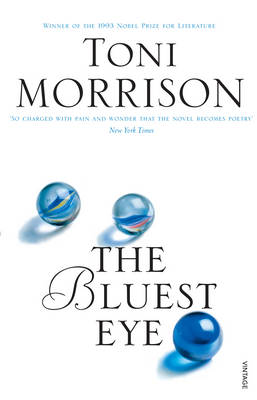
Toni Morrison’s The Bluest Eye: Black Girls as Central Figures
[By Goyland Williams]
The same year The Bluest Eye (1970) was published, the Black Power Movement and other black struggles for liberation of the 1960s had influenced black literature significantly. Central to those movements’ message was the emphasis of loving and valuing blackness. Because of this, Toni Morrison describes in a interview why The Bluest Eye having “a little hurt black girl at the center of this story” instead of the stereotypical strong black woman is substantial, and even, groundbreaking in a landscape known for its essentialist representations.
Tuesday, September 13, 2011
Playing in the Sunlight: Colors of Imagination, or Toni Morrison Revisited
 Having made proposals about the continual and continuous Africanist presence in the American literary imagination, Toni Morrison positions herself to be questioned about the invisible presence of an other, neither black nor white, which does or should haunt the American use of language. Should the case be otherwise, it would have to be claimed that the truly invisible other has been so thoroughly erased in historical consciousness and printed text as to be of minuscule importance. Morrison’s translation of her 1990 Massey lectures as Playing in the Dark: Whiteness and the Literary Imagination raises serious questions about the “inadequacy and the force of the imaginative act,” particularly when that phrase is juxtaposed with the amazing utterance “How compelling is the study of those writers who take responsibility for all of the values they bring to their art” (xiii). One of Morrison’s most valuable points in the book concerns the debatable validity of certain constructions of knowledge. It is an invitation to ask about her own constructions, in light of her disclaimer that she does not bring to the critical project “even principally the tools of a literary critic.” Do the tools of the literary artist suffice? And in this instance, might we think (with a tinge of perversity) that failure would be more valuable than success in helping us to understand Morrison as novelist/critic?
Monday, August 29, 2011
Struggles for Freedom: Kanye West and Toni Morrison’s Artistic Renderings of Flight
 Please leave your thoughts in the comment section
[By Kenton Rambsy]
Tony Bolden, author of Afro-Blue: Improvisations in African American Poetry and Culture, proposes “vernacular cultures are always dialogic relative to dominant cultures, so they are never static but rather always in flux...writers (artists) who appropriate the vernacular must confront the constant risk of erasure” (26). Bolden’s concept of the ever-changing vernacular culture helps to explain frequent reimagings of slavery and struggles for liberation by black literary artists.
Black writers, musicians, and other artists working in a range of genres use vernacular language to re-envision history and re-image the legacy of enslaved persons. Defiantly, against most popular appraisals of history, these artists validate the independence, intelligence, and ingenuity of their enslaved ancestors through their artistic renderings.
Monday, April 25, 2011
Literary Vantage Points: Multiple Perspectives of Toni Morrison
Literary Vantage Points is the HBW’s newest initiative geared towards engaging our audience members in conversations about African American literature. We are looking to make short video segments a regular feature on our blog in order to utilize the most effective digital mediums and spark dialogue among people interested in black artist production.
We have collected brief interviews from a number of professors to get their perspectives about various authors. In this particular feature, we asked three literary scholars—Professors Donna Akiba Sullivan Harper, Opal Moore, and Aldon Lynn Nielsen—to describe their initial impressions of author Toni Morrison and discuss the legacy of her work.
The goal of these interviews is to reveal the diverse nature of African American literature. These three scholars provide very different responses about how they became acquainted with Toni Morrison and the aesthetic value of her work. Please join us as we begin a new chapter of HBW history.
Video Editing: Howard Rambsy Sr.
Video Concept: Kenton Rambsy
Video Footage: Crystal Boson and Yuan Ding
Video Editing: Howard Rambsy Sr.
Video Concept: Kenton Rambsy
Video Footage: Crystal Boson and Yuan Ding
Subscribe to:
Posts (Atom)